
Vinyl Fence Repair in Twin Falls, Idaho
Not every damaged vinyl fence needs to be torn out. If the problem is limited to a panel, a post, a rail, or a gate, repair is usually the better call. A cracked panel does not mean the whole fence is done. Neither does a section that leans or a gate that stopped closing right.
The real question is what actually failed.
Sometimes it is obvious. A panel is cracked. A post is loose. A rail popped out of its bracket.
Other times it takes a closer look. A fence can lean because the footing shifted below the ground, not because anything above ground is wrong. A gate can drag because the gate post moved, not because the hinges are bad.
That is why a real inspection matters before anyone starts swapping parts. Twin Falls Fencing repairs vinyl fencing across Twin Falls and the surrounding area. Depending on what we find, that might mean fixing one section, replacing a few components, or telling you honestly that replacement makes more sense.
Common Vinyl Fence Repairs
A vinyl fence is made of a handful of parts working together. Posts hold everything up. Rails run horizontal and tie the sections together. Panels or pickets sit between the rails. Gates add hinges, latches, and moving hardware on top of all that.
Any one of these parts can fail on its own.
The fence repairs we see most often:
- Broken or cracked vinyl panels
- Damaged fence posts
- Loose posts
- Leaning fence sections
- Broken or loose rails
- Panels pulling away from posts
- Sagging gates
- Broken gate hinges
- Damaged latches
- Wind damage
- Vehicle or equipment damage
- Missing or broken post caps
- Sections that need full replacement
Some of these are quick fixes. Others point to something bigger going on underneath.
Here is an example. Replacing a cracked panel solves the problem if something hit it and that is the whole story. But if several panels are separating because the posts behind them shifted, a new panel will not fix anything. It just delays the same failure.
Repairing Broken Vinyl Fence Panels
A cracked or broken panel is the most obvious vinyl fence problem you will run into.
Panels crack from lawn equipment, vehicles, falling branches, heavy objects, and wind. Cold weather makes some vinyl stiffer too, so the same impact that would leave a mark in summer can crack a panel in winter.
How you fix it depends on the fence type and how it was put together in the first place.
Often the damaged panel comes out and a new one goes in without touching the rest of the fence. Simple in theory. The hard part is matching the material.
Vinyl fencing is not one product. Profiles, wall thickness, color, rail dimensions, and manufacturing systems all differ. A panel from one manufacturer usually will not fit rails and posts from another.
Older fencing makes this worse, because the original product line may not even be made anymore.
Before you replace a panel, check the posts and rails around it. If those are loose or damaged too, a new panel by itself will not hold.
Vinyl Fence Post Repair
Posts matter more than people give them credit for.
You can have solid panels and solid rails and the fence can still fail if the posts underneath are moving.
A post leans for a few reasons. The footing shifted. The ground moved. It was not set deep enough to start with. Or something hit it hard enough to knock it out of position.
Signs something is wrong with a post:
- A section of fence leaning
- Rails pulling away from the post
- Panels no longer lining up
- A gate that suddenly will not latch
- A post that moves when you push on it
- Gaps opening between sections
The fix depends on why the post moved in the first place. If the post is damaged, it gets replaced. If the footing failed, the post gets reset. Sometimes we have to dig around the post to actually see what is going on below ground before deciding.
One mistake we see a lot: someone pushes a leaning fence back upright and props it there. That looks fine for a while. It does not fix why the post moved. If it keeps shifting, the rails and panels attached to it eventually take damage too.
Vinyl Fence Gate Repair
Gates break down faster than the rest of the fence because they move every single time someone uses them.
Hinges carry the weight. The latch has to line up exactly right. The gate posts have to stay straight for any of that to work.
Even a small amount of movement causes real problems.
A gate might start dragging on the ground. It might get hard to close. The latch might stop lining up. Sometimes the whole gate looks crooked while the rest of the fence looks fine.
Possible causes:
- Loose hinges
- Damaged hardware
- A gate frame that has shifted
- A leaning gate post
- Poor alignment from the original install
- Ground movement
- Years of opening and closing
The right fix starts with figuring out what is actually out of place.
Adjusting the latch might solve a small problem. It will not fix a leaning gate post. Replacing hinges will not help either if the post holding those hinges is the thing actually moving.
Wind Damage and Vinyl Fence Repair
Privacy fencing takes the worst of wind damage because solid panels catch more wind than an open-style fence does.
When wind hits the fence, that force runs through the panels, into the rails, and down into the posts. Whatever part was already weak usually fails first.
After a windy stretch, homeowners often notice:
- A section leaning
- Panels that have come loose
- Rails pulled out of posts
- Cracked components
- Posts that have shifted
- Sections that no longer line up
Inspecting wind damage sooner rather than later matters here. A loose section moves more in the next wind than a secure one does. That extra movement puts more stress on whatever is still holding it together.
A repair that starts as one post or one rail can turn into a much bigger job if the fence keeps moving before anyone deals with it.
When Vinyl Fence Repair Makes Sense
Repair usually makes sense when most of the fence is still in good shape.
A fence with one damaged section can still have years of life left in it.
Repair is worth doing when:
- Only one or two sections are damaged
- Most of the posts are still solid
- Replacement parts are available
- There are no widespread structural problems
- The repair will actually restore proper alignment and strength
There is no reason to replace an entire fence over a problem that is limited to one area, as long as the rest is sound.
That said, repeated repairs on a fence with problems everywhere can stop being worth the money. That is where an inspection actually helps you decide.
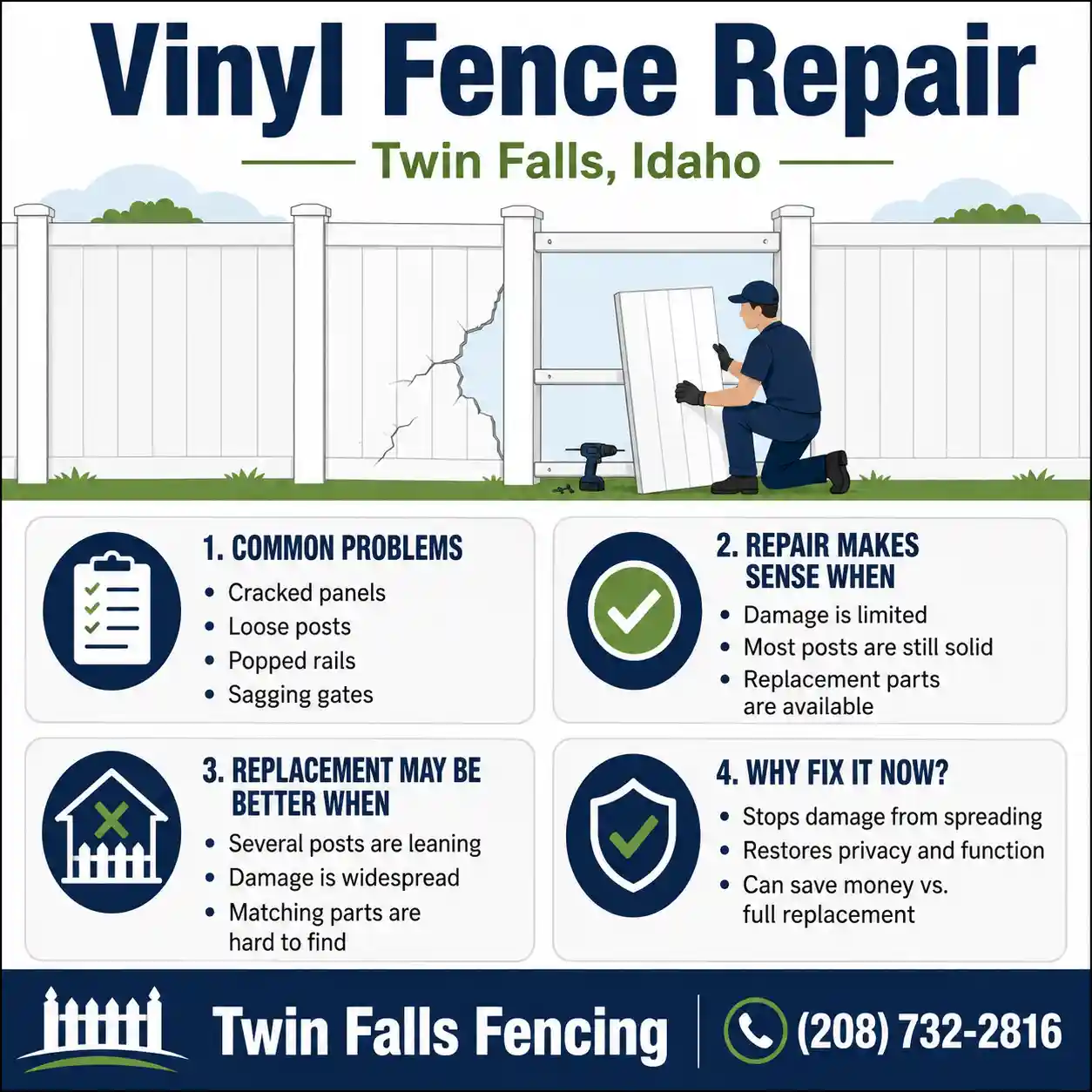
When Replacement May Make More Sense
Sometimes repair is technically possible but replacement is the smarter move.
If several posts are leaning, multiple panels are cracked, rails are failing in different spots, or the fence has taken repeated damage, the repair costs start stacking up fast.
Older fencing is harder to repair too, since matching replacement parts might not exist anymore.
Matching is its own problem. Even if a replacement panel physically fits, new vinyl often will not look exactly like material that has weathered outside for years. Sun, dirt, and age change the color and finish over time.
None of that rules out repair. It is just something worth thinking through before replacing visible sections one at a time.
How Much Does Vinyl Fence Repair Cost?
Fence repair costs depend almost entirely on what is actually damaged. Replacing a latch and resetting multiple posts are two completely different jobs.
Main factors that affect the price:
- Number of damaged sections
- Type of fence
- Number of posts involved
- Whether concrete footings need work
- Whether matching replacement parts are available
- Gate repairs
- How much disassembly is required
- Site access
- Cleanup and disposal
A single damaged panel is usually a fairly straightforward job. Several leaning posts take a lot more labor, since each connected section may need to come apart and go back together.
If you want a more detailed price breakdown, see our guide on how much it costs to repair a vinyl fence.
Common Vinyl Fence Repair Mistakes
The biggest mistake people make is fixing the visible damage and skipping the cause.
You can replace a cracked panel just fine. But if the post next to it is still moving, the new panel ends up under the same stress that broke the old one.
Another mistake is forcing parts into place that do not actually fit anymore. Vinyl fence systems are built to connect in specific ways. Forcing rails or panels into position creates tension that tends to cause another failure down the line.
Using the wrong parts is a related issue. Two pieces of white vinyl fencing can look almost identical and still have different dimensions. Rails may not seat properly in post openings. Panels may be slightly too thick or too narrow.
Gate repairs get mishandled often too. If a gate will not latch, moving the latch might look like it fixed things. If the gate post is actually leaning, the problem keeps getting worse regardless.
The repair has to target the cause. Fixing the symptom alone does not hold.
What Happens If Vinyl Fence Damage Is Ignored?
Not every damaged fence is an emergency. But structural problems rarely fix themselves.
A loose post keeps moving. A rail that is partly pulled out eventually comes free completely. A dragging gate keeps putting stress on its hinges and post.
Damage spreads too. One weak post affects every section connected to it. If those sections keep moving in the wind, nearby rails and posts start carrying extra stress they were not built for.
There are practical downsides as well. A damaged privacy fence stops providing full privacy. A loose gate might not stay shut. Broken sections leave gaps pets and kids can get through.
If the fence is leaning toward a sidewalk, driveway, neighboring property, or anything else, that is worth handling sooner rather than later.
Can You Repair a Vinyl Fence Yourself?
Some small repairs are within reach for a homeowner. Swapping a latch or a post cap does not usually take much more than basic tools and the right replacement part.
Structural repairs are a different story.
Resetting posts, replacing rails, taking sections apart, and fixing gate alignment is more involved work. If concrete footings are involved, several connected sections may need to come apart just to reach the damaged post.
There is also the question of whether the repair actually worked. A fence can look straight the day the work finishes and still have a weak post hiding underneath.
If you are not sure why the fence failed in the first place, it is usually worth having someone look at it before buying parts.
Vinyl Fence Repair in Twin Falls and the Magic Valley
Twin Falls Fencing repairs vinyl fencing throughout Twin Falls and the surrounding communities.
We handle broken panels, damaged posts, loose rails, leaning sections, gate problems, and the other common vinyl fence issues that come up.
Replacement is not the automatic answer. We look at what is damaged, what is still solid, and whether repair is the practical choice.
Sometimes that is one part. Sometimes several connected sections need to come apart and go back together. And sometimes the condition of the fence means replacement really is the better option.
It depends on the fence in front of us.
If you have damaged vinyl fencing, photos help before you even call. A few clear pictures of the damaged area, the nearby posts, and the full section give us a better idea of what might be involved.
Get an Estimate for Vinyl Fence Repair
If your vinyl fence has a broken panel, a leaning post, a loose rail, a damaged gate, or storm damage, it is worth finding out whether repair is realistic before assuming the whole fence has to go.
Twin Falls Fencing provides vinyl fence repair in Twin Falls, Idaho, and the surrounding Magic Valley.
Contact us to have the damage evaluated and get an estimate for the repair.