
Best Privacy Fence Materials for Homes
Cedar hits the sweet spot for most situations. Runs $20-30 per linear foot installed in Twin Falls, lasts 15-25 years if you maintain it, blocks sight lines completely at six feet. Vinyl costs more – $25-40 per foot – but you never touch it again after installation and it pushes 30-plus years easy. Composite lands in between at $30-45 per foot, gives you 25-30 years, barely any upkeep. Pressure-treated pine is the budget play at $15-22 per foot but only makes it 10-15 years and needs sealing regularly or it fails faster.
Privacy comes down to three things. Height matters most – six feet blocks views for normal-height people. Board spacing has to be tight, talking quarter-inch gaps max. Material density determines whether light shows silhouettes through. Solid wood and vinyl are totally opaque. Some cheaper stuff lets shadows through in bright conditions.
We install everything at Twin Falls Fencing. What makes sense depends on your budget, how long you’re staying, and whether you’ll actually do maintenance. Being realistic about residential fencing maintenance matters because lots of people say they’ll seal their fence every few years and then they just don’t.
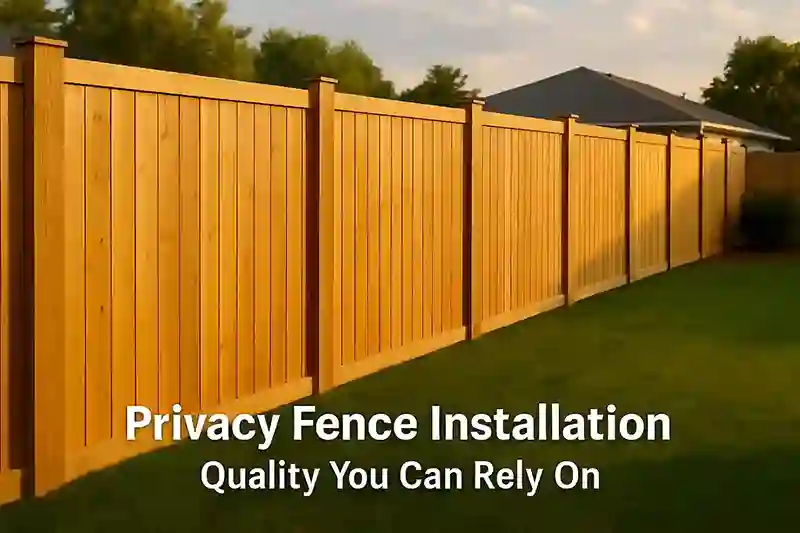
Cedar Works for Most People
Cedar naturally fights off rot and bugs. Has oils in the wood that termites hate and fungus can’t get started in. Twin Falls is dry enough this matters less than humid places but it still adds years compared to regular pine or fir.
Starts out reddish-brown. Looks great. Then it weathers to gray within 2-3 years if you don’t seal it. Some people dig the weathered look. Lots of others hate it and wish they’d sealed it from the start. Either way the fence stays structurally solid, it’s just a color thing.
Boards warp some over time because wood is wood. Even kiln-dried cedar has moisture in it. Twin Falls air is dry, so as that moisture leaves the wood, boards twist a bit. Good contractors space things right and use proper fasteners to minimize it but you’ll still get maybe 5-10 percent of boards showing visible warp after 5-7 years. Not terrible but it happens.
Materials cost $12-18 per foot for boards, rails, posts. Labor adds $8-12 per foot on top. So you’re looking at $20-30 total per foot for standard six-foot privacy fence. Eight-foot costs more. Premium cedar grades cost more.
Maintenance is sealing every 2-3 years if you want the color and maximum life. Sealer runs $30-50 per gallon, covers maybe 150-250 square feet depending how thirsty the wood is. A 150-foot fence eats 2-3 gallons. You can DIY it in a weekend. Pros charge $1.50-3 per square foot to do it.
In Twin Falls you get 15-25 years out of cedar. The dry climate helps a ton. Cedar in humid places rots faster from constant moisture. Here the enemies are UV breaking down the wood and wind throwing debris into it.
Vinyl Just Sits There Forever
Vinyl is extruded PVC plastic shaped like fence parts. Doesn’t rot. Bugs won’t eat it. Never needs paint or sealer. That’s the whole point – put it up and forget about it.
Privacy is perfect. Zero gaps between pickets on privacy-style vinyl. Completely solid. No light gets through at all. Six-foot vinyl fence gives you total privacy from anyone standing at ground level.
Color holds for ages. White vinyl might yellow slightly after 15-20 years of sun but it’s barely noticeable unless you’re comparing it directly to brand new panels. Tan and gray hold color even better. Cheap vinyl chalks up and fades faster though. You get what you pay for like everything else.
Temperature makes vinyl expand and contract. Panels grow or shrink maybe quarter inch across seasonal temperature changes. Installers who know what they’re doing leave gaps at connections so it can move. Bad installers don’t, then the fence binds up or buckles when it expands in summer heat.
Impact cracks it. Car backs into vinyl fence, it’s cracked. Tree branch falls on it, damage. But normal stuff – kids playing, dogs running into it, wind – handles fine. It’s tough but not indestructible.
Costs $25-40 per foot installed depending on style and quality. Basic white privacy vinyl is cheapest end. Woodgrain textures, fancy tops, premium brands push higher. Materials run $15-25 per foot. Labor is $10-15 per foot.
Maintenance is basically nothing. Wash it once a year if it gets dirty. That’s it. No sealing, no painting, no treatments. Over 30 years that saves you thousands compared to maintaining wood.
Lasts 30-plus years easily. Good vinyl installed right goes 40-50 years in Twin Falls. Dry climate means no moisture problems. UV is the only thing breaking it down and modern vinyl handles UV way better than old formulations did.
Pressure-Treated Pine When Money’s Tight
Treated pine costs less than cedar or vinyl. If your budget is maxed out and you need privacy now, treated pine works. Just know what you’re getting into.
Treatment forces chemical preservatives deep into the wood under pressure. Stops rot and bugs. Without treatment pine would be trash in 5-7 years. With it you get 10-15 years.
Wood quality is lower than cedar. More knots everywhere. Warps more. Grain is less consistent. Treated pine fences look rougher than cedar even when they’re brand new. Few years in and the difference gets more obvious.
Comes out greenish from the treatment chemicals. Fades to tan-gray as it sits outside. Most people stain it to cover the green which looks weird. Staining costs same as sealing cedar – $1.50-3 per square foot from pros or $30-50 per gallon if you do it yourself.
Maintenance needs match cedar. Seal or stain every 2-3 years or it fails early. Skip maintenance and you’re looking at 8-12 years instead of 12-15. Keep up with it and you hit the upper end of that range.
Runs $15-22 per foot installed. Materials cost $9-13 per foot. Labor costs $6-9 per foot. That’s 25-35 percent less than cedar, 40-50 percent less than vinyl.
Privacy performance is identical to cedar if you install it with same board spacing and height. Wood type doesn’t change how well it blocks views. Only changes how long it lasts and how it looks.
Makes sense when you’re in a temporary situation or budget is really that tight. Planning to sell in 5-7 years? Treated pine gets you to the sale. Need fence now and can’t swing cedar pricing? Treated pine gives you privacy immediately, upgrade later if you want.
Composite Mixes Plastic and Wood Fiber
Composite boards are recycled wood fiber mixed with recycled plastic. Comes out looking sort of like wood but acting more like vinyl.
Privacy is complete. Boards install tight, no gaps. Material is solid opaque. No see-through or light transmission issues.
Appearance depends on who makes it. Some composite looks fake as hell. Others do a decent job mimicking wood grain. Colors are browns, grays, weathered tones. Generally looks better than vinyl but not as real as actual wood.
Maintenance is minimal like vinyl. Doesn’t need sealing or staining. Wash it sometimes. Some composite can grow mold in humid climates but Twin Falls is too dry for that to happen.
Durability is strong. Doesn’t rot. Doesn’t split like wood does. Doesn’t crack like vinyl can. Handles impacts pretty well. Temperature swings don’t make it expand and contract as much as vinyl does.
Costs $30-45 per foot installed. Materials are $18-28 per foot. Labor runs $12-17 per foot. Sits between vinyl and premium cedar on price.
Some people like the recycled content angle. Keeps waste out of landfills. Takes less energy to make than virgin vinyl. If that matters to you, composite scores well there.
Lasts 25-30 years minimum. Some manufacturers warranty it for 25 years. Material is newer than wood and vinyl so data past 25 years is limited. But projections say 35-40 years total.
Metal Privacy Fence Is Different
Aluminum and steel do privacy fences but they’re not traditional slat fences. Metal privacy uses panels – solid sheets or really tight pickets.
Corrugated metal panels block everything. Popular in modern and industrial looks. Not everyone’s style. Some HOAs won’t allow metal privacy fence because of how it looks.
Aluminum slat fences use thin vertical or horizontal slats spaced super close. Gives you privacy while letting air through. Different look than solid fence. More contemporary design.
Cost is all over. Basic corrugated metal runs $15-25 per foot installed. Premium aluminum slat systems hit $40-60 per foot. Powder-coated finishes cost more but look better and last longer.
Maintenance is low. Metal doesn’t rot or decay. Powder coat lasts 15-20 years before wearing. Bare metal develops patina or rust depending on type. Some people like aged metal appearance. Some hate it.
Durability is extremely high. Metal fence goes 30-50 years easy. Aluminum doesn’t rust. Steel rusts if coating fails but metal underneath still holds structure. Wind resistance is excellent if it’s anchored right.
Privacy depends on design. Solid panels block 100 percent. Slat designs might let narrow sight lines through at certain angles. Works for most privacy needs but not as total as solid wood or vinyl.
Twin Falls wind favors metal. Handles high wind better than wood or vinyl. Doesn’t blow down in storms. We install metal privacy mainly for modern homes and commercial stuff. Residential is growing but still limited.
Chain Link with Slats Is Compromise
Regular chain link provides zero privacy. See right through it. But weaving privacy slats into the mesh creates partial privacy.
Privacy slats are thin strips of vinyl, metal, or composite that thread through chain link. Block most sight lines but not completely. Certain angles you still see through gaps between slats.
Costs $12-18 per foot installed. Cheaper than real privacy fence but gives less privacy. Makes sense when budget is extremely tight or regulations require chain link but you want some privacy.
Looks industrial. Doesn’t look like wood or vinyl privacy fence at all. Fine for side yards or places where appearance matters less. Not great for backyard where you’re entertaining and want nice-looking fence.
Maintenance is low. Slats fade over time, might need replacing after 10-15 years. Chain link structure lasts 20-30 years easy. Replacing faded slats costs $3-6 per foot.
We don’t recommend chain link with slats for primary privacy. It’s a compromise. If you can afford actual privacy fence, get that. Chain link with slats works for specific situations – rental properties, temporary privacy, extreme budget situations.
Height Actually Matters for Privacy
Six feet is standard privacy height. Blocks views for people under five foot ten or so. Covers most adults. Taller people see over six-foot fence but most can’t.
Four feet doesn’t give you privacy. Average adult sees right over four-foot fence easily. That height works for decorative boundaries or keeping small dogs in. Not privacy.
Eight feet gives total privacy even from tall people. But eight-foot fence costs more, needs permits in most places, and makes darker enclosed spaces. Only necessary for specific stuff – next to two-story homes, properties by busy streets, extreme privacy requirements.
Height combines with solid boards for real privacy. Six-foot fence with gaps between boards doesn’t provide privacy no matter how tall it is. Boards need to touch or overlap. Gap-board designs like shadowbox let air through but you sacrifice privacy.
Board Spacing and How Contractors Install
Boards have to install tight for complete privacy. Good contractors space boards with quarter-inch gap or less. Lets wood move slightly while blocking views.
Sloppy work leaves bigger gaps. Half-inch gaps still give decent privacy from distance but let viewing from close angles. Inch-wide gaps wreck the privacy completely.
Board-on-board uses overlapping boards on alternating sides of rails. Complete privacy from both sides while air circulates. Costs 15-20 percent more than standard boards because more material and more labor.
Shadowbox intentionally leaves gaps with offset boards. Creates visual pattern and airflow. Privacy gets compromised – you see through shadowbox from certain angles. Popular for decorative fencing but wrong choice for maximum privacy.
Twin Falls Climate Affects Materials
Dry climate here helps all materials. Wood doesn’t rot fast. Vinyl doesn’t get moisture problems. Metal doesn’t corrode like it does in humid places. The 210 sunny days per year means UV is main thing breaking materials down.
Temperature swings stress everything. Summer hits 90. Winter drops to 20s. That 70-degree swing causes expansion-contraction cycles. Vinyl handles this by design. Wood cracks if it’s too dry at installation. Composite does fine. Metal doesn’t care.
Wind hits all fences. Twin Falls gets intense wind. Proper installation depth and bracing matters more than material. Shallow posts fail whether fence is cedar, vinyl, or composite. Deep posts succeed with any material.
UV breaks down cheap materials faster. Cheap vinyl chalks. Untreated pine grays and splinters. Quality materials with UV blockers hold up decades. Worth paying for quality if you’re staying long-term.
Total Cost Over 20 Years
Cedar costs $20-30 per foot installed plus $600-1,200 maintenance every 2-3 years. Over 20 years that’s $3,000-4,500 installation plus $4,000-8,000 maintenance totaling $7,000-12,500 for 150-foot fence.
Vinyl costs $25-40 per foot installed plus basically nothing for maintenance. Over 20 years that’s $3,750-6,000 total for 150-foot fence.
Composite costs $30-45 per foot installed plus minimal maintenance. Maybe $300-500 over 20 years for cleaning. Total is $4,500-6,750 plus $300-500 coming to $4,800-7,250 for 150-foot fence.
Pressure-treated pine costs $15-22 per foot installed plus $600-1,200 maintenance every 2-3 years. But needs replacement at 12-15 years. So $2,250-3,300 initial plus $3,000-6,000 maintenance totals $5,250-9,300 then add another $2,250-3,300 for replacement bringing it to $7,500-12,600 total.
Vinyl and composite win on total cost despite costing more upfront. Cedar costs similar to pressure-treated when you add maintenance. These numbers assume you actually maintain the fence. Skip maintenance and wood fails faster, costs go up.
What Actually Makes Sense
For most Twin Falls homes we say cedar or vinyl. Cedar if you like real wood and don’t mind some maintenance. Vinyl if you want zero maintenance and longer life.
Tight budget people should think about pressure-treated short-term or save up for cedar. Spending $2,000-3,000 on treated pine then replacing it in 10 years costs more total than spending $3,000-4,500 on cedar once.
High-end homes benefit from composite or premium vinyl. Appearance and performance justify higher cost. Metal privacy works for modern architecture but doesn’t fit traditional homes.
Rental properties do fine with pressure-treated or cheap vinyl. Renters won’t maintain wood properly. Vinyl eliminates maintenance problems. Cheap pine gives privacy without huge investment.
HOA restrictions change what you can do. Some HOAs require specific materials or ban others. Check rules before deciding. Getting approval after installation is way harder than checking first.
Installation Quality Beats Material Choice
Best material installed wrong fails faster than mediocre material installed right. Posts have to go below frost line – 24 inches minimum, 30 inches better in Twin Falls. Concrete has to cure right. Boards have to space correctly.
Cheap contractors cut corners everywhere. Shallow posts, not enough concrete, sloppy board spacing. Fence looks fine at first but fails within 5-7 years instead of lasting like it should.
Get written quotes with installation specs detailed. Post depth, concrete volume, board spacing, what fasteners they use. Compare quotes on installation quality not just price. Lowest bid usually means lowest quality work.
Check contractor references. Ask specifically about longevity. Did their fences from 10 years ago hold up? Or did they fail early from poor work?
How to Actually Decide
Start with budget. What can you spend upfront? What can you spend on maintenance? Total cost over time matters more than just installation cost.
Think about timeline. Staying 5 years or 20 years? Short timeline means cheaper initial cost matters. Long timeline means lower maintenance and longer life matters.
Be honest about maintenance. Like weekend projects? Cedar sealing isn’t bad. Hate maintenance? Vinyl or composite eliminates it.
Look at aesthetics. What looks right on your house? Modern home can do metal privacy. Traditional home looks better with wood or vinyl that looks like wood.
Check local rules. Height limits, setback requirements, material restrictions. Know rules before planning.
Contact Twin Falls Fencing for honest assessment. We’ll tell you what works for your situation and what doesn’t. No pressure to pick expensive stuff. Just real information so you decide smart.
Best privacy fence material depends on your specific situation. Cedar, vinyl, and composite all work well in Twin Falls. Choose based on budget, maintenance preferences, and how long you’re keeping the fence. Any of these installed correctly gives excellent privacy for years.