
How Much Does it Cost to Repair a Vinyl Fence?
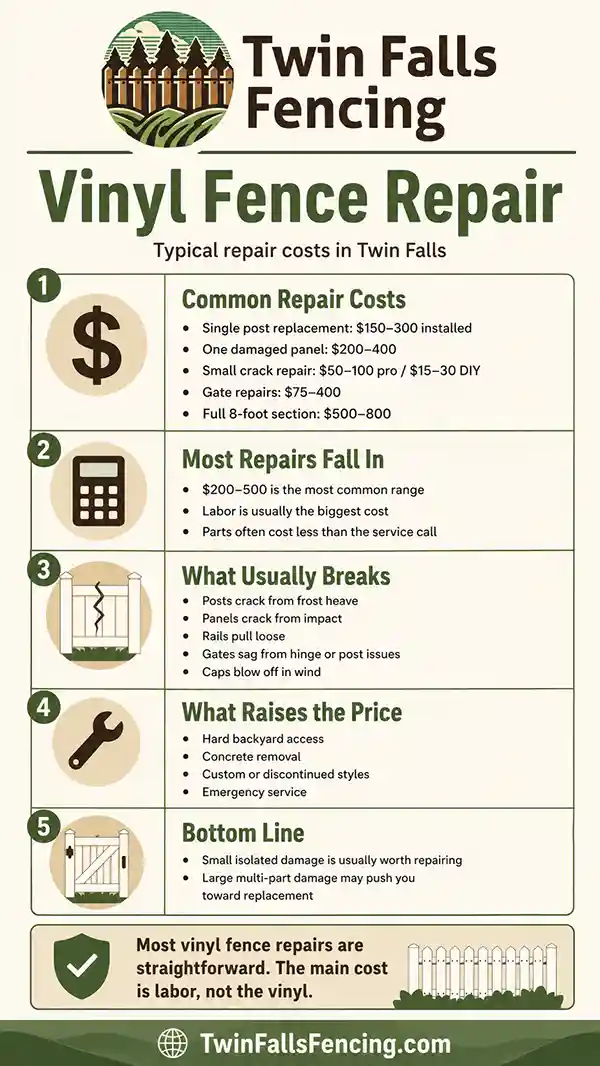
Single vinyl fence post replacement runs $150-300 installed. Replacing one damaged panel costs $200-400 depending on panel size and style. Small crack repairs using vinyl cement cost $50-100 if a pro does it, $15-30 for DIY materials. Gate repairs range from $75 for hinge replacement up to $400 for complete gate replacement. Full section replacement – posts, rails, and pickets for 8 feet of fence – hits $500-800.
Most vinyl fence repairs fall into the $200-500 range because you’re typically replacing one or two components, not rebuilding entire sections. The material costs less than the labor in most cases. Vinyl fence parts are relatively cheap. Getting someone to show up, assess the damage, and do the work properly is where money goes.
Twin Falls Fencing handles vinyl fence repairs but honestly most damage to vinyl fences happens from impact or improper installation. The material itself holds up great in our climate. When repairs are needed, they’re usually straightforward replacements rather than complex fixes. If you need someone to fix the damage, learn more about our vinyl fence repair services in Twin Falls.
What Actually Breaks on Vinyl Fences
Posts crack from ground heaving during freeze-thaw cycles. Twin Falls gets enough freezing to cause some ground movement. If posts weren’t set deep enough initially – and many aren’t – winter frost pushes them upward. That creates stress cracks near ground level. Sometimes the entire post splits vertically.
Panels crack from impact. Lawnmowers, vehicles backing up, kids throwing things, falling tree branches. Vinyl is tough but not indestructible. A direct hit from something heavy moving fast will crack it. The cracks usually run from the impact point outward in a star pattern.
Rails pull loose from posts. The rail-to-post connection uses routed channels and sometimes screws. Over time these connections can work loose, especially if the fence wasn’t assembled tightly during installation. Wind load stresses these joints constantly.
Gates sag because hinges loosen or posts shift. Vinyl fence posts for gates need deeper setting and sometimes concrete reinforcement. Without proper support, gate posts lean over time from the weight and repeated opening-closing stress. Then hinges bind and gates won’t close properly.
Caps blow off in wind. Those decorative post caps just push on. High winds catch them and they’re gone. This is more cosmetic than structural but people want them replaced.
UV damage causes chalking and brittleness after 15-20 years on cheap vinyl. Quality vinyl holds color and flexibility longer. Lower-grade material breaks down under constant sun exposure. Twin Falls gets 210 sunny days per year. That UV adds up.

Post Replacement Costs
Standard 4×4 inch vinyl fence post costs $25-50 depending on quality and where you buy it. The post itself is cheap. Installation is not.
You need to dig out the old post. If it was set in concrete, you’re digging out concrete too. That’s 24-36 inches deep and 12-16 inches diameter. Takes an hour or more depending on soil conditions and how much concrete is down there.
New post goes in the same hole ideally. Mix and pour fresh concrete. Set the post plumb. Let it cure. That’s another hour of labor minimum plus concrete costs around $10-15 per post.
Then you reconnect the fence panels or rails to the new post. Sometimes this requires partial disassembly of adjacent sections. Add another 30-60 minutes.
Total labor runs 2-3 hours for single post replacement. At $75-100 per hour for fence contractor labor in Twin Falls, you’re looking at $150-300 for labor. Plus materials brings the total to $185-365 for one post.
Some companies charge flat rates for post replacement. $250-300 per post is common. If you need multiple posts replaced, the per-post price might drop because setup time is already covered.
Panel Replacement is Usually Easier
Vinyl fence panels range from $100-250 depending on height and style. Standard 6-foot privacy panel costs $120-180. Decorative styles with lattice tops or ornamental designs cost more.
Replacing a panel takes less time than replacing a post. You’re removing damaged panel, inserting new panel into the existing rails, and securing it. Maybe 45-60 minutes of work for straightforward replacement.
Labor costs $75-150 depending on how the fence is constructed. Some vinyl fences use panels that slide into channels on posts and rails. Others use individual pickets that insert into rails. Panel-style fences are faster to repair.
Total cost for panel replacement runs $200-400. The material is half the cost. Labor is the other half. If multiple panels need replacement, labor costs per panel decrease.
Matching the exact style matters. Vinyl fence manufacturers change their product lines. A fence installed 10 years ago might not have exact replacement panels available anymore. Close matches usually work but color might not be perfect. Older vinyl yellows or grays slightly. New panels will be brighter white.
Small Crack Repairs
Vinyl cement works for small cracks under 6 inches long. The cement is basically liquefied PVC that melts into the crack and bonds the vinyl together as it dries. A tube costs $8-12 at hardware stores.
Clean the crack thoroughly. Apply the cement. Hold or clamp the crack closed while it sets. Let it cure 24 hours. That’s it for DIY repair. Takes 15-20 minutes of actual work.
Professional crack repair using vinyl cement costs $50-100. You’re paying for someone to show up. The actual repair is quick. Most contractors won’t drive out for a single small crack repair unless they’re already in the area or you bundle it with other work.
Crack repairs work only on small, clean cracks. If the crack goes through multiple structural points or if the vinyl is shattered, replacement is necessary. Crack repair is temporary fix on major damage. The crack will likely extend further within a year or two.
Gate Repairs Break Down Multiple Ways
Hinge replacement costs $75-125. New hinges run $20-40 for a set. Installation takes 30-45 minutes. Just unbolt old hinges, bolt on new ones, adjust for proper swing and closure.
Latch replacement is $50-75. Latches cost $15-25. Installation is quick, maybe 20 minutes. But contractors charge minimum service call fees so even simple latch work hits that $50-75 minimum.
Post straightening for gates is more involved. If the gate post has shifted and the gate binds, you might need to reset the post. That’s similar to full post replacement – dig it out, set it properly in new concrete. Costs $200-350 depending on whether the post itself is damaged or just poorly positioned.
Gate panel replacement costs same as fence panel replacement, $200-400. But gates often need the frame rebuilt too if impact damage occurred. Frame rebuild adds $100-200 in labor.
Complete gate replacement – new gate, new hinges, new latch – runs $300-600 depending on gate size and style. Standard 4-foot walk gate costs less than double 6-foot drive gate.
When Repair Makes Sense Versus Replacement
Repair makes sense when damage is isolated to one or two components. Single cracked post? Repair it. One broken panel? Replace that panel. The rest of the fence is fine.
Repair costs under $500 are usually worth it. Your fence probably cost $3,000-6,000 to install originally. Spending $300 to fix localized damage extends the fence life by years.
Multiple repairs needed at once change the calculation. If you’re looking at three posts, four panels, and gate work, that’s $1,500-2,500 in repairs. At that point, evaluate the fence overall condition. Maybe the entire installation is failing and full replacement makes more sense.
Age matters significantly. Vinyl fence less than 10 years old is worth repairing almost always. The bulk of the fence will last another 10-15 years minimum. Fence over 20 years old with multiple problem areas might be near end of life. Repairing old fence just delays inevitable replacement.
Warranty coverage affects the decision. Many vinyl fences carry 20-30 year warranties. Check if your damage is covered. Impact damage usually isn’t. Manufacturing defects and UV degradation often are. If warranty applies, repair costs drop to just labor.
DIY Versus Professional Repairs
Panel replacement is doable for DIY if you’re reasonably handy. The panels aren’t that heavy. You need basic tools – drill, level, maybe a rubber mallet. Biggest challenge is getting the panel positioned correctly in the rail channels.
Post replacement requires more skill and equipment. You need a post hole digger or auger. You need concrete mixing capability. You need to set the post perfectly plumb and at correct height. Mess this up and the fence looks bad or functions poorly. Most homeowners should hire this out.
Crack repairs are easy DIY. Buy the vinyl cement. Follow directions on the tube. It’s not complicated. Saves you $40-80 in labor costs.
Gate repairs depend on the specific problem. Replacing hinges or latches is straightforward DIY. Resetting a gate post is professional work. Rebuilding a gate frame is professional work unless you have fence-building experience.
The tradeoff is time versus money. DIY saves labor costs but takes your time and risks improper repair. Improper repair might need professional fix later, costing more total. Professional work costs more upfront but gets done correctly and usually faster.
What Increases Repair Costs
Difficult access adds cost. If the damaged section is in your backyard and workers need to haul materials through your house or around the side with limited clearance, that adds time. Time is money. Expect 15-25 percent cost increase for hard-to-reach locations.
Concrete removal increases labor significantly. Post set in concrete takes longer to remove than post set in gravel or soil. Some old installations used excessive concrete – 50-pound pours per post. Digging that out is serious work. Can add an extra hour per post.
Custom or discontinued styles cost more. Standard white privacy fence has readily available replacement parts. Decorative styles or unusual colors might need special ordering. That delays the repair and increases material costs.
Emergency service costs more. Need your fence fixed today because your dog keeps escaping? That’s premium pricing. Contractors charge 50-100 percent more for same-day or next-day service versus scheduling 1-2 weeks out.
Multiple small repairs across different locations cost more per repair than clustered damage. Efficiency drops when workers need to move equipment multiple times. One damaged section costs $300 to fix. Three damaged sections in different areas might cost $250 each.
Twin Falls Specific Considerations
Wind damage is common here. Twin Falls gets intense wind events during spring and sometimes winter. Wind doesn’t break vinyl fences often, but it can if panels weren’t properly secured or if posts weren’t set deep enough. Post-storm fence repairs spike in demand. Prices might increase 10-20 percent during busy repair periods.
Freeze-thaw ground movement causes more damage here than in milder climates. Posts need to be set below frost line – 24 inches minimum, 30 inches better. Shallow post installation causes problems after a few winter cycles. Repairing these posts requires proper depth this time.
UV exposure is significant with 210 sunny days per year. Lower-quality vinyl shows UV damage within 10-15 years. Chalking, discoloration, brittleness. Once UV damage is extensive, repairs become frequent. Better to replace the whole fence with quality vinyl.
Dry climate is actually good for vinyl fences. No moisture-related problems. No rot, no mold, no water damage. The repairs we do are almost entirely impact or installation-related, not climate damage.
Preventing Damage Reduces Repair Costs
Trim vegetation away from fence. Tree branches rubbing on vinyl in wind cause abrasion. Roots growing under posts can push them up. Keep clearance of 12-18 inches between fence and trees or large shrubs.
Install proper drainage if water pools near fence posts. Water doesn’t hurt vinyl but repeated freeze-thaw in saturated soil causes ground heaving. Good drainage reduces frost action.
Mark fence location clearly in winter. Snowplow damage to fences is expensive. Stake the fence line so snow removal equipment operators can see where the fence is.
Check gate hardware annually. Tighten loose hinges before they cause post damage. Lubricate moving parts. Adjust latches before they break. Five minutes of maintenance prevents $200 repairs.
Watch for settling or shifting. Catch problems early. A post starting to lean is easier to fix than a post that’s completely failed. Early intervention costs less.
Real Costs for Common Repairs
One cracked post near ground level from frost heave: $225-300. Two damaged privacy panels from tree branch impact: $450-700. Gate sagging from loose hinges: $100-150. Complete 8-foot section replacement after vehicle backed into fence: $600-900. Small crack repair using vinyl cement: $75 professional, $12 DIY materials.
These are actual Twin Falls pricing ranges. Your costs might vary based on contractor, fence style, and damage severity. Get written quotes before authorizing work.
Working With Twin Falls Fencing for Repairs
We handle vinyl fence repairs when they make economic sense. Sometimes we tell customers repair isn’t worth it and replacement is smarter. We’re honest about that because spending your money on temporary fixes doesn’t help anyone long-term.
Most Kimberly vinyl fence and other Magic Valley repairs we do cost $200-500. That’s the range where repair delivers good value. Under $200 and you might DIY it. Over $500 and you’re starting to approach partial fence replacement territory where extending the repair scope might be smarter.
We stock common vinyl fence parts for popular styles. Unusual styles need ordering. That adds 1-2 weeks to the repair timeline. Standard white privacy fence parts we have or can get within days.
Call us for assessment if you’re unsure about your damage. We’ll tell you what it costs to fix and whether fixing makes sense. Honest information helps you make smart decisions about your fence.
Vinyl Fence Repair FAQs
Q: What does vinyl fence repair actually cost in Twin Falls?
A: Depends on what broke. A cracked post runs $225–$300 to replace, installed. One damaged panel is $200–$400. Small crack repair done by a pro is $50–$100. You can do it yourself for $15–$30 in materials. Gate hinge replacement is $75–$125. Full 8-foot section — posts, rails, pickets — lands at $500–$800. Most jobs fall in the $200–$500 range because it’s usually one or two parts, not a full rebuild. The vinyl itself is cheap. Labor and showing up is where the cost actually comes from. Twin Falls Fencing gives free estimates, so call before assuming the worst.
Q: Should I repair or just replace the whole fence?
A: If it’s one post or one panel and the fence is under 15 years old, repair it. It’s not a close call. Your fence cost $3,000–$6,000 to put in. A $300 fix makes sense. Where that changes is when damage is stacking up. Three bad posts, several panels, gate problems — now you’re at $1,500 or more in repairs. At that point get a replacement quote too and compare. Old fence, 20-plus years, beat up in multiple spots? Probably not worth it. You’re just delaying the same conversation.
Q: What’s actually breaking vinyl fences out here in the Magic Valley?
A: Two things, mostly. Impact and frost heave. The freeze-thaw cycles in Twin Falls push soil around. Posts set less than 24 inches deep get lifted by frost over a few winters. That puts stress at the base and cracks them vertically. Impact damage is lawnmowers, cars backing up, tree branches coming down — anything that hits hard enough. Rails also pull loose from posts when the original installation was sloppy. Wind knocks post caps off. That’s cosmetic but people still want it fixed. UV does real damage too, but only after 15–20 years and mostly on lower-grade vinyl. Twin Falls gets 210 sunny days a year, so cheap material breaks down faster here than somewhere cloudier.
Q: Can a cracked vinyl panel be repaired, or does it need to go?
A: Small crack, under 6 inches, clean edges — vinyl cement works. It’s liquefied PVC that bonds into the crack. Clean it, apply it, hold it shut, let it cure a full 24 hours. That’s a real fix, not just a patch. Bigger cracks, shattered areas, cracks running through a structural section of the panel — replace it. Vinyl cement on major damage buys you a year, maybe. The crack keeps going. If you’re not sure, look at where the crack starts and ends. If it’s heading toward a rail or post connection point, don’t bother patching.
Q: How long does vinyl fence repair take?
A: Panel swap is 45–60 minutes on a normal job. Post replacement is 2–3 hours minimum — dig out the old one, deal with the concrete if it’s there, set the new one, pour fresh concrete, wait for cure. Gate hinge swap is 30–45 minutes. Resetting a shifted gate post takes closer to 3 hours. Concrete cure means the fence might not be fully stable until the next day. Most repairs are single-visit jobs. Twin Falls Fencing will tell you upfront what the timeline looks like when they come out.
Q: Does Twin Falls Fencing have parts on hand, or does it take weeks?
A: Standard white privacy fence parts are usually available fast — in stock or a few days out. Older styles, discontinued lines, unusual colors — that’s 1–2 weeks to order. Worth knowing: manufacturers change their product lines. A fence from 10 years ago might not have an exact match anymore. A close match works fine structurally. Color might be slightly off until the new section weathers a bit. That’s normal.
Q: Will homeowner’s insurance pay for vinyl fence repair?
A: Sometimes. Policies that cover named perils — wind, falling trees, vehicle impact — will usually cover the damage. They won’t cover freeze-thaw cracking, general wear, or anything where neglect is obvious. If a storm hit, take photos before touching anything and file the claim. Get a written estimate from Twin Falls Fencing for the adjuster. If the repair is under your deductible, just pay it out of pocket. Faster and less hassle.
Q: How do you keep vinyl fence repairs from happening in the first place?
A: Trim branches back from the fence line. Anything rubbing in the wind causes damage over time and roots can push posts up from underneath. Mark your fence before winter so plows don’t hit it. Check gate hinges once a year — tighten anything that’s worked loose. Gate posts take constant stress from weight and movement. A loose hinge caught early is a $10 fix. Ignored for two seasons it becomes a post reset. Check for water pooling near posts. Wet soil freezes harder and heaves more. None of this takes long. It’s the kind of thing that actually saves money.