Installation Process for Agricultural Projects
Free on-site estimates include walking the property, assessing terrain and soil conditions, discussing livestock types and management plans, measuring actual perimeter. Large projects require survey documents or GPS coordinates for accurate quotes.
We provide detailed written quotes breaking down materials, labor, corner assemblies, gates, and any site-specific costs. Material quantities calculated precisely. No vague estimates that change later.
Timeline depends on project size and terrain. Quarter-mile on flat ground takes 2-3 days with our crew and equipment. Mile of fencing takes 6-10 days depending on corners, gates, and obstacles. Rocky soil or heavy vegetation adds time.
We coordinate utility locates through 811. Required by law. Takes 3 days minimum. Irrigation lines, power lines, gas lines all need marking before we dig posts. Hitting buried lines costs thousands in repairs.
Corner posts and bracing go in first. These carry all fence tension. They must cure 24-48 hours before tensioning wire. Line posts can be set and used immediately with proper tamping.
Wire installation happens after all posts are set and cured. We tension from one end to the other in single continuous runs where possible. Splices create weak points. Minimizing them improves fence performance.
Why Installation Quality Matters for Agricultural Fencing
Post depth determines everything. Posts set 24 inches deep shift within 3-5 years in Twin Falls soil. Frost heave at 24-inch frost line pushes them up and sideways. The entire fence becomes crooked. Wire loosens. Gates don’t close properly.
We set line posts 30-36 inches deep. Corner posts and gate posts go 42-48 inches. Below frost line with substantial margin. Takes longer. Uses more concrete or requires more tamping. But the fence stays straight for 25+ years.
Corner assemblies are critical. They resist all the pulling force of tensioned wire. Weak corners mean failed fence regardless of wire quality. We build corners with 6-8 inch diameter posts, horizontal brace rails, diagonal wire or wood bracing creating triangulation. This locks everything solid.
Some contractors use 4-inch corner posts to save money. They fail within 5-10 years. The diameter difference costs $15-25 per post but the longevity difference is 15+ years. False economy.
Proper tensioning requires experience and equipment. Too tight and wire breaks or pulls posts inward. Too loose and livestock push through. Correct tension has slight give when pushed but springs back firmly. You learn this through thousands of feet of installation, not reading instructions.
Twin Falls clay soil moves substantially with moisture changes. Expands when wet, contracts when dry. This puts constant stress on fence posts. Proper installation techniques account for this movement. Poor installation fights it and fails.
Livestock-Specific Fencing Solutions
Cattle Fencing
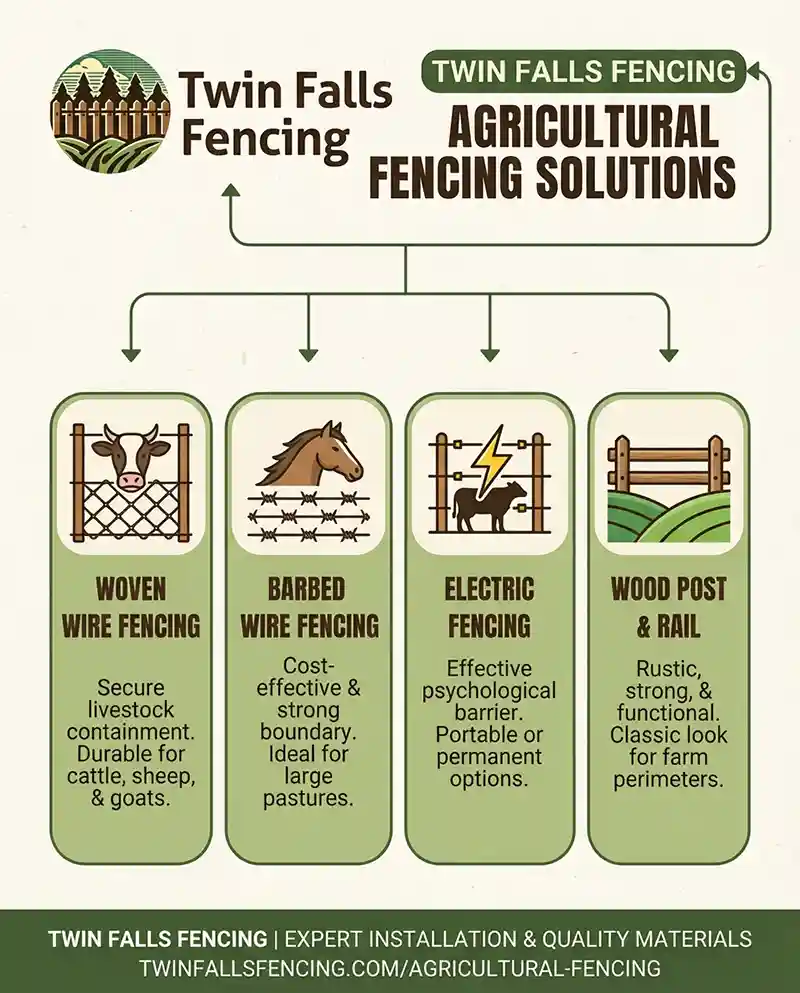
Cattle are easiest to fence. They don’t jump, don’t climb, and respect barriers once trained. Five-strand barbed wire or 47-inch woven wire both work well.
Cow-calf operations need reliable containment but not premium materials. Standard barbed wire performs fine. Calves stay with mothers. Neither challenges the fence aggressively.
Stocker operations with younger cattle benefit from woven wire. Young cattle are flightier and more likely to test fences. The solid barrier prevents escapes that barbed wire might not.
Bull containment requires stronger fence. Bulls challenge fences more aggressively. Woven wire with electric top strand works well. High-tensile with closely-spaced bottom strands also effective. Five-strand barbed alone is marginal for mature bulls.
Horse Fencing
Horses require different approach. They’re flighty, they jump when spooked, and they get tangled easily. Safety is paramount.
Woven wire with 48-60 inch height and tight bottom spacing works well. The V-mesh or graduated spacing patterns prevent legs catching. Never use barbed wire for horses.
High-tensile smooth wire is excellent for horses. Five to seven strands at proper spacing creates visible, safe barrier. Add electric top strand and horses learn boundaries quickly.
Board fencing looks best but costs $12-20 per foot. Premium horse operations often use this for visible areas and woven wire for back boundaries. The combination balances appearance and budget.
Sheep and Goat Fencing
Sheep and goats need 48-inch minimum height with 6-inch or tighter spacing at bottom. Both species are escape artists. Any gap gets tested repeatedly.
Woven wire is basically required. Barbed wire won’t contain them. They walk right through the spacing. Electric fence works but they challenge it constantly and you better have backup.
Goats are worse than sheep. They climb. They jump. They squeeze through impossibly small gaps. Some operations add electric offset wires to keep goats from climbing woven wire. The offset shocks them when they try.
Gate Installation for Agricultural Properties
Agricultural gates see heavy use. Tractors, trucks, ATVs, livestock movement. They need commercial-grade construction and hardware.
Standard farm gates are 10-16 feet wide. Twelve feet accommodates most equipment. Fourteen to sixteen feet for larger tractors and implements. Gates narrower than 10 feet create bottlenecks for livestock movement.
Gate posts need extra strength. Six to eight inch diameter posts set 42-48 inches deep. Braced like corner posts because they carry similar stress from constant opening and closing plus occasional livestock pressure.
Commercial gate hinges cost $40-80 per gate. Worth every penny. They have heavier gauge metal, better bushings, and handle thousands more cycles than residential hardware. Cheap hinges fail within 2-3 years on agricultural gates.
We stock tube gates, chain link gates, and custom-built gates depending on application. Tube gates are most common for livestock. Chain link for equipment yards. Custom gates for unusual openings or specific requirements.
Plan more gates than you think you need. Checking water, moving livestock, equipment access, emergency vehicle entry. Each requires gates in logical locations. Adding gates later costs more than installing them during initial construction.
Regional Considerations for Southern Idaho
Twin Falls clay soil shifts constantly. Wet season expansion and dry season contraction move posts unless properly set. We go deeper than minimum recommendations and use larger diameter holes with excellent compaction.
Alkali soil affects treated posts and concrete. Chemical reactions accelerate deterioration. We use posts with copper-based treatments and concrete additives formulated for alkali conditions.
Wind load is substantial. Spring winds regularly hit 40+ mph with gusts over 60. Fence acts like a sail. Proper corner bracing and post spacing prevent blow-downs that happen with inadequate installations.
Snow drift can bury fence sections. Animals use snow as steps to jump over. In heavy snow areas, either raise fence height or plan for snow removal from fence lines. This particularly affects woven wire and solid fences.
Temperature extremes from -15°F to 95°F stress all materials. Wire expands and contracts. Wood posts split. Proper installation techniques accommodate this movement rather than fighting it.
Project Sizes We Handle
Small acreage (1-5 acres): Hobby farms, small horse properties, backyard livestock. Quarter-mile or less of fencing. We handle these regularly. Two to four day projects typically.
Medium operations (5-40 acres): Larger horse facilities, small cattle operations, mixed livestock farms. Half-mile to mile of fencing. Four to ten day projects depending on terrain and complexity.
Large operations (40+ acres): Cattle ranches, large-scale farming operations, commercial livestock facilities. Multiple miles of fencing. Multi-week projects requiring crew coordination and staged installation.
We have equipment and crew capacity for projects of any size. Small tractor-mounted auger for tight spaces. Large excavator-mounted auger for big projects. Multiple crews available for large installations requiring quick completion.
Cost Factors and Pricing
Base costs assume relatively flat terrain, decent soil, normal access, no major vegetation removal needed.
Terrain significantly affects pricing. Rolling hills require more corner assemblies and careful planning. Rocky soil breaks equipment and slows installation dramatically. Heavy sagebrush or juniper requires removal before fencing. Each adds 20-50% to base costs.
Distance from Twin Falls factors into pricing. Projects within 30 miles: standard rates. Thirty to fifty miles: small travel fee. Beyond 50 miles: evaluate case by case. Large projects justify travel. Small projects often don’t.
Typical agricultural fencing costs:
Quarter-mile barbed wire: $4,000-8,000
Quarter-mile woven wire: $7,000-12,000
Quarter-mile high-tensile: $6,000-10,000
Quarter-mile electric: $3,000-6,000
These include materials, labor, standard corners (4 for quarter-mile square), one gate, and normal installation conditions. Add for difficult terrain, extra gates, or premium materials.
Our article on fencing 20 acres for cattle provides detailed cost breakdowns for larger projects if you’re planning substantial acreage. For a quick estimate at any acreage, try our acreage fence cost calculator.
Maintenance and Repair Services
We handle fence repairs and maintenance for agricultural operations. Post replacement, wire tightening, gate adjustments, section rebuilding.
Post replacement costs $150-300 per post depending on size and accessibility. We can often replace posts without removing entire fence sections. Dig out failed post, set new one, reattach existing wire.
Wire tightening runs $200-500 per quarter-mile depending on how loose it’s gotten. Sometimes just needs re-tensioning. Sometimes requires splicing new sections where wire has broken.
Gate repairs range from $75 for simple hinge adjustment to $500 for complete gate replacement with new hardware. Agricultural gates take substantial abuse. Regular maintenance prevents complete failure.
Annual inspection services available. We walk your fence line, identify problems, provide written report with recommended repairs and cost estimates. Catching problems early prevents expensive failures during calving season or when you need the fence most.
DIY Support and Material Sales
We sell fencing materials to customers doing their own installation. Wire, posts, gates, hardware, tensioning equipment. Contractor pricing, not retail markup.
We provide technical advice for DIY projects. Help calculate material quantities. Explain installation techniques. Answer questions as they come up. We’d rather see a fence installed correctly with our materials than see someone struggle with inadequate guidance.
Some customers hire us for difficult parts – corners, gates, rocky sections – while handling straight runs themselves. This balances budget and ensures critical components are done right. We’re flexible on hybrid approaches.
Rental equipment available for serious DIYers. Tractor-mounted auger rental saves substantial time over hand tools. Commercial fence stretchers tension wire properly. Professional levels ensure straight posts.
Permits and Regulations
Most agricultural fencing in Twin Falls County doesn’t require permits. But there are exceptions.
Fencing near county roads may need approval. Setback requirements vary by road classification. Check before installing fence along public right-of-ways.
Boundary fences require neighbor communication about location and potential cost-sharing. Idaho is fence-in state for livestock. You’re responsible for containing your animals. Document any cost-sharing agreements in writing.
Water rights and irrigation access have specific rules. Can’t block legal water rights. Fencing near canals or ditches needs irrigation district approval. We help navigate these requirements.
Service Area in Southern Idaho
Twin Falls Fencing serves Twin Falls County and surrounding agricultural areas. Regular service area includes Jerome, Buhl, Kimberly, Filer, Hansen, Murtaugh, Castleford, Rogerson, and throughout Magic Valley.
We’ve completed projects in Cassia County, Minidoka County, and Gooding County. Distance affects scheduling and potentially pricing but doesn’t prevent us from taking projects.
Large agricultural projects justify travel to more distant locations. Multi-mile fencing installations make economic sense even with travel time. Contact us about your specific location regardless of distance.
Why Choose Twin Falls Fencing for Agricultural Projects
We understand agricultural needs differ from residential. Functionality matters more than appearance. Budget constraints are real. Projects need completion around farming schedules, not our convenience.
Experience with working properties means we know where gates need to go for equipment access. We understand livestock behavior and fencing requirements for different species. We’ve worked with irrigation systems and know how to fence around them without causing problems.
Proper equipment makes us efficient. Large projects get done in days or weeks, not months. You need your fence operational. We don’t drag projects out unnecessarily.
We warranty agricultural installations same as residential. Five years on workmanship. If posts heave, corners fail, or installation errors appear, we fix them at no charge. Agricultural fencing is an investment. It should last decades.
Schedule Your Agricultural Fencing Estimate
Contact Twin Falls Fencing for free on-site consultation. We’ll walk your property, discuss your livestock and management plans, assess terrain and soil conditions, and provide detailed written estimate.
Call [phone number] or use our website contact form. We respond within 24 hours. Large projects get scheduled based on timeline requirements and crew availability.
Twin Falls Fencing – Agricultural fencing installation throughout southern Idaho. Licensed and insured. Locally owned and operated. Serving farmers and ranchers since [year].