
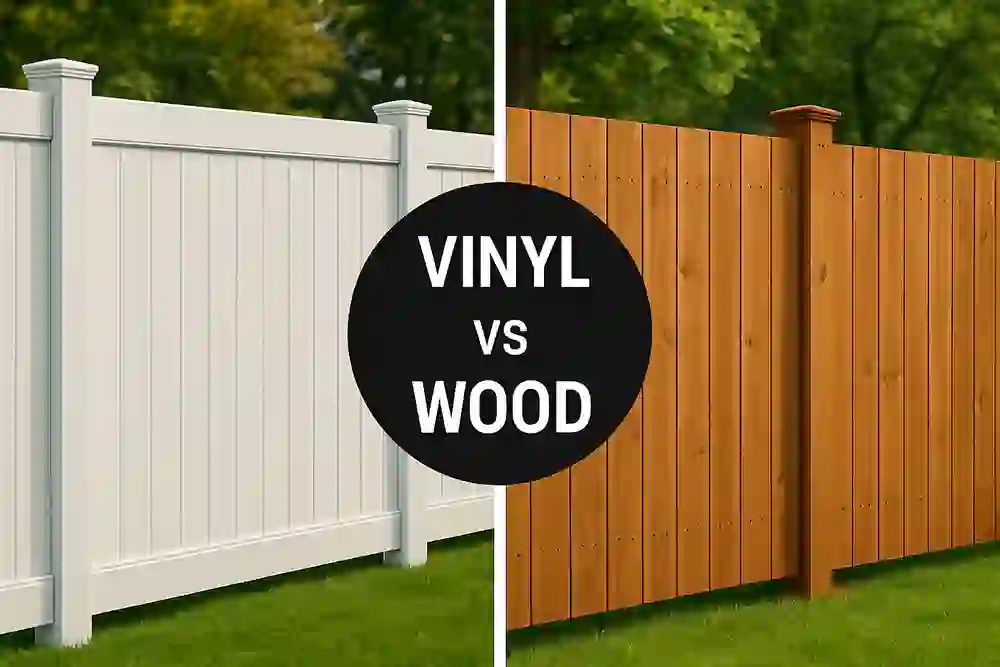
Vinyl vs Wood Fencing: The Real Comparison
Wood costs less upfront. Vinyl costs less long-term. Choose wood fencing if you have a lower upfront budget ($18-25 per foot), don’t mind maintaining it every 2-3 years, and want natural appearance with design flexibility. Choose vinyl fencing if you want minimal maintenance, plan to stay long-term, and can afford $25-35 per foot upfront. Over 20 years, vinyl actually costs less when you factor in wood’s $2,500-5,000 maintenance expenses.
At Twin Falls Fencing, we install both types constantly. Some customers choose wood knowing they’ll maintain it. Others pick vinyl specifically to avoid maintenance. Both choices work if they match your priorities and budget.
Let’s break down the actual differences in cost, maintenance, appearance, durability, and how each performs in Twin Falls weather.
Upfront Cost Reality
Wood privacy fencing runs $18-25 per linear foot installed in Twin Falls. Cedar costs $20-25 per foot. Pine comes in at $18-22 per foot. These are real installed prices for 6-foot privacy fence with standard posts and rails.
Vinyl privacy fencing costs $25-35 per linear foot installed. Quality vinyl that won’t get brittle in Idaho sun sits at $28-35 per foot. Cheap vinyl at $22-25 per foot looks tempting but fails in 7-10 years.
For a typical 150-foot backyard fence, wood costs $2,700-3,750 installed. Vinyl runs $3,750-5,250 installed. That’s $1,000-1,500 more for vinyl.
The cost gap narrows with better wood. Cedar at $3,300-3,750 versus quality vinyl at $4,200-4,800. Suddenly you’re looking at $900-1,000 difference instead of $1,500.
Gates add to either option. Wood gates run $200-400 each depending on size. Vinyl gates cost $300-500. The hardware and construction requirements are similar.
Maintenance: Where Vinyl Wins Big
Wood fencing needs sealing or staining every 2-3 years. Skip this and the wood dries out, cracks, and starts rotting. One cycle of neglect costs you years of fence life.
Sealing a 150-foot fence costs $200-400 in materials if you do it yourself. Hiring it out runs $600-1,000. Every 2-3 years. Over 20 years, that’s $2,000-4,000 in maintenance you can’t avoid.
Individual boards need replacement as they crack or rot. Budget for replacing 10-20 boards over 20 years at $15-25 per board plus your time. Another $300-500.
Total maintenance cost for wood over 20 years: $2,500-5,000. Add that to the installation cost and wood suddenly isn’t cheap.
Vinyl fencing needs washing twice a year. Soap and water. Garden hose. Takes 30 minutes. That’s it. No sealing, no staining, no painting. The color goes all the way through so scratches don’t show like they do on painted surfaces.
Maintenance cost for vinyl over 20 years: maybe $100 for cleaning supplies. The time investment is minimal. Our fence maintenance guide covers what little upkeep vinyl requires compared to wood.
Time Cost Matters Too
Sealing or staining a fence takes a full weekend. Cleaning, sealing, drying. You’re committed. Every 2-3 years. Over 20 years that’s 7-10 weekends of work.
Some people enjoy the work. Most don’t. If your time is valuable or you’d rather be doing literally anything else, vinyl saves you 60-80 hours over two decades.
Appearance and Style Options
Wood looks natural. The grain shows through stain. It fits traditional architecture. Some people just prefer wood aesthetically and that’s a valid reason to choose it.
You can stain wood any color. Change it later if you want. Cedar ages to silver-gray naturally if left untreated. Some people like that look. Most don’t.
Wood fence styles include privacy, shadowbox, board-on-board, picket, split rail. Lots of design flexibility. Custom patterns are possible. Wood cuts and shapes easily.
Vinyl comes in white, tan, gray, and a few wood-tone colors. The color is permanent. You can’t change it later. The options are more limited than wood.
Modern vinyl mimics wood grain fairly well. Not perfectly. Up close you can tell it’s vinyl. From 20 feet away it looks fine. The texture has improved dramatically over the last 10 years.
Vinyl fence styles match wood options: privacy, semi-privacy, picket, rail. The designs aren’t quite as varied as wood but cover most needs.
According to the National Association of Home Builders, alternative materials like vinyl are increasingly popular for their durability and low maintenance, though wood remains preferred for traditional aesthetics.
At Twin Falls Fencing, we show customers samples of both materials. See them side by side. Touch them. That helps people decide based on actual appearance rather than assumptions.
Durability in Twin Falls Climate
Idaho weather is brutal. Temperature swings from -10°F to 95°F. 220+ sunny days per year at 3,800 feet elevation. UV radiation 15% more intense than sea level. Freeze-thaw cycles 40-60 times per winter.
Cedar fences last 18-22 years with proper maintenance in Twin Falls. Pine lasts 12-15 years. Without maintenance, cut those numbers in half. As we cover in our article about fence lifespan in Twin Falls, maintenance makes or breaks wood fence longevity.
The south and west sides of wood fences fail first. Maximum sun exposure. Maximum wind exposure. Plan on those sections needing attention 3-5 years before the north and east sides.
Posts rot at ground level. This happens even with treated posts if drainage is poor. We set posts with 6 inches of gravel at the bottom to prevent this. Many installers skip this step.
Quality vinyl fences last 25-30 years in Twin Falls. Cheap vinyl gets brittle and cracks in 10-15 years. The difference is UV stabilizers and titanium dioxide content throughout the material.
We only install commercial-grade vinyl at Twin Falls Fencing. The cheap stuff saves $5-8 per foot upfront but fails early. We’ve seen too many brittle vinyl fences to recommend anything but quality materials.
Vinyl color affects lifespan. White reflects heat and lasts longest. Dark colors absorb heat and degrade faster by 2-3 years. Not a huge difference but worth knowing.
Wind and Impact Resistance
Wood has some flex to it. High winds bend it but usually don’t break it. Individual boards can crack or split but the fence typically survives storms.
Properly installed wood fencing handles Twin Falls wind fine. We get spring gusts over 50 mph regularly. Good post spacing and adequate bracing prevent blow-downs.
Vinyl is more rigid. It doesn’t flex like wood. In extreme winds, vinyl panels can crack or snap rather than bend. Quality vinyl is engineered to handle this better than cheap vinyl.
Impact resistance favors wood. A basketball thrown at wood fence bounces off. Same ball can crack vinyl. Lawn mowers kicking up rocks damage vinyl more easily than wood.
This matters if you have kids, dogs, or equipment operating near the fence. Wood takes abuse better. Vinyl shows damage more readily and can’t be patched as easily.
Repair and Replacement
Replacing a damaged wood board takes 10 minutes. Remove the old board, cut a new one, attach it. Costs $15-25 per board plus your time. Any homeowner can do this.
Matching stain on the new board to weathered fence is harder. Fresh stain stands out. Over time it blends in as everything ages together.
Replacing vinyl panels is more involved. Panels interlock. Sometimes you need to remove multiple panels to replace one. Not difficult but more complex than wood board replacement.
Matching vinyl color is easier. It’s molded that color. A new panel matches perfectly. No weathering concerns.
Vinyl panels cost $50-150 each depending on size and style. More expensive than individual wood boards but you’re replacing a larger section.
We keep common vinyl panel sizes in stock at Twin Falls Fencing. See our vinyl fence repair cost guide for a full breakdown of post, panel, and gate repair pricing. Wood is easy since we can cut to size on site. Either material is repairable but wood is simpler.
Installation Differences
Wood and vinyl installation follow similar processes. Set posts, attach rails, install boards or panels. The fundamentals are identical.
Wood is more forgiving during installation. Board spacing can vary slightly. Heights can be adjusted easily. Mistakes are fixable without waste.
Vinyl requires more precision. Panels are manufactured to specific sizes. Everything must be level and square or panels don’t fit right. Less room for error.
Both require proper post installation. That’s where most fence failures originate. Posts set wrong fail regardless of material. At Twin Falls Fencing, we set posts 30-36 inches deep with proper drainage for both wood and vinyl.
Installation time is similar. A professional crew installs either type at about the same pace. The skill requirements are comparable.
Environmental Considerations
Wood is renewable. Trees grow back. Cedar and pine come from managed forests in most cases. At end of life, wood decomposes or can be burned.
Wood treatment chemicals raise concerns for some people. Modern treatments don’t use arsenic anymore. Current preservatives are safer but still chemicals.
Vinyl is petroleum-based plastic. It’s not renewable. Manufacturing uses energy and produces emissions. Recycling vinyl fence is possible but not common.
Vinyl lasts longer so you’re not replacing it as often. That counts for something. One vinyl fence over 30 years versus two wood fences over the same period.
Neither option is perfectly green. Wood wins on renewability. Vinyl wins on longevity. Your environmental priority determines which matters more.
Resale Value and Buyer Preferences
Good fencing increases property value regardless of material. A well-maintained wood fence or a clean vinyl fence both add appeal.
Some buyers prefer wood for traditional aesthetics. Others love vinyl for the maintenance-free aspect. It’s not universally one or the other.
Neglected wood fence hurts property value. Gray, weathered, obviously unmaintained wood signals deferred maintenance throughout the property. Bad impression.
Old but clean vinyl looks better than neglected wood. Even 20-year-old vinyl maintains decent appearance with just washing. That’s an advantage at resale time.
Real estate agents in Twin Falls tell us buyers appreciate quality fencing. Material matters less than condition. A maintained wood fence sells as well as vinyl.
HOA and Code Requirements
Most homeowner associations in Twin Falls allow both wood and vinyl. Some restrict colors or styles. Check your HOA rules before deciding.
Some HOAs prefer wood for aesthetic consistency in the neighborhood. Others allow vinyl but limit colors to white or tan. Requirements vary widely.
City building codes treat wood and vinyl similarly. Height restrictions apply to both. Setback requirements are identical. Permit costs are the same.
Twin Falls Fencing handles permit applications for customers. We know what the city requires and how to get approval without delays.
Special Situations
Sloped yards are easier with wood. You can adjust board heights individually to follow terrain. Vinyl panels are fixed height and work better on level ground or stepped installations.
Curves and angles work better with wood. Individual boards bend and angle easily. Vinyl panels are rigid and require specific curved or angled pieces that cost more.
Swimming pool fencing has code requirements about spacing. Both materials meet code but wood offers more flexibility in meeting specific gap requirements.
Dog owners often prefer vinyl. Dogs can’t chew it. It doesn’t splinter. Easy to clean when dogs rub against it or do their business near it. Wood absorbs odors and moisture more.
Fire Risk
Wood burns. Vinyl melts. Neither is fire-resistant. In wildfire-prone areas, both materials pose similar risks.
Vinyl generates toxic smoke when burning. Wood smoke is harmful too but different chemicals. If fire risk is a major concern, consider metal fencing instead.
Making the Decision
Choose wood if you: prefer natural appearance, want design flexibility, don’t mind maintenance, have lower upfront budget, plan to change colors or styles later.
Choose vinyl if you: want minimal maintenance, plan to stay long-term, value time over money, want consistent appearance, don’t mind limited color options.
For most Twin Falls homeowners, the decision comes down to maintenance willingness. If you’ll actually seal the fence every 2-3 years, wood works great. If you know you won’t, vinyl is worth the extra cost.
We see people choose wood then neglect it. Five years later they’re calling about replacement. If you’re honest with yourself about maintenance habits, you’ll make the right choice.
Cost Analysis Over 25 Years
Cedar fence: $3,500 installation + $3,000 maintenance + $500 repairs = $7,000 total over 25 years. Then it needs replacement.
Vinyl fence: $4,500 installation + $100 maintenance + $200 repairs = $4,800 total over 25 years. Still has 5-10 years of life left.
The numbers flip around year 12-15. Early on, wood is cheaper. Long-term, vinyl costs less. The break-even point depends on your specific maintenance costs and frequency.
What We Recommend
At Twin Falls Fencing, we don’t push one material over the other. We install both constantly and both work when matched to the right customer.
We do recommend quality materials regardless of choice. Cheap vinyl fails early. Untreated or poor-quality wood rots fast. The material quality matters more than the material type.
For front yards with high visibility, wood often looks better and fits neighborhood aesthetics. For backyards where function matters more than appearance, vinyl makes sense.
If budget is tight, consider wood with a plan for maintenance. If budget allows and you want hands-off fencing, vinyl is worth the investment.
Hybrid Approaches
Some customers use both materials strategically. Vinyl on sides and back where maintenance access is difficult. Wood on the front where appearance matters and it’s easier to maintain.
This approach balances cost, maintenance, and aesthetics. Total cost falls between all-wood and all-vinyl. Maintenance is reduced compared to all-wood.
We can design systems that mix materials logically. The transition points need planning so it doesn’t look like you ran out of money halfway through the project.
Questions to Ask Yourself
Will you actually maintain a wood fence every 2-3 years? Be honest. If the answer is no, choose vinyl.
Do you plan to stay in this house 10+ years? Vinyl’s long-term value improves with longer ownership.
What’s your budget including maintenance? Don’t just look at installation cost. Factor in the ongoing expense.
Do you have kids or dogs that will impact the fence? Wood handles abuse better than vinyl.
Is natural appearance important enough to justify maintenance? Wood looks more natural but requires work.
Common Mistakes
Choosing cheap vinyl to save money. It fails early and costs more in the long run. If budget is too tight for quality vinyl, wood is better.
Buying wood without committing to maintenance. The fence looks terrible in 5 years and you’re replacing it at 12 years instead of 20.
Forgetting about gates. Quality gate hardware matters for both materials. Cheap hardware fails in 2-3 years regardless of fence type.
Not considering your climate. In Twin Falls with high UV and temperature extremes, material quality is critical for both wood and vinyl.
Get Professional Advice
The vinyl vs wood fencing decision affects your property for decades. Making the right choice based on your specific situation matters.
Twin Falls Fencing offers free consultations. We’ll visit your property, discuss your priorities and budget, show you material samples, and help you make an informed decision.
We install both materials regularly. We’re not pushing one over the other. We want you to get the fence that fits your needs and that you’ll be happy with long-term.
Whether you choose wood for its natural beauty or vinyl for its convenience, we’ll install it properly with quality materials that last. The installation quality determines performance regardless of material choice.
Contact Twin Falls Fencing to discuss your fence project. We’ll answer your questions, address your concerns, and help you choose between vinyl and wood based on facts rather than marketing claims.